

SERMONS
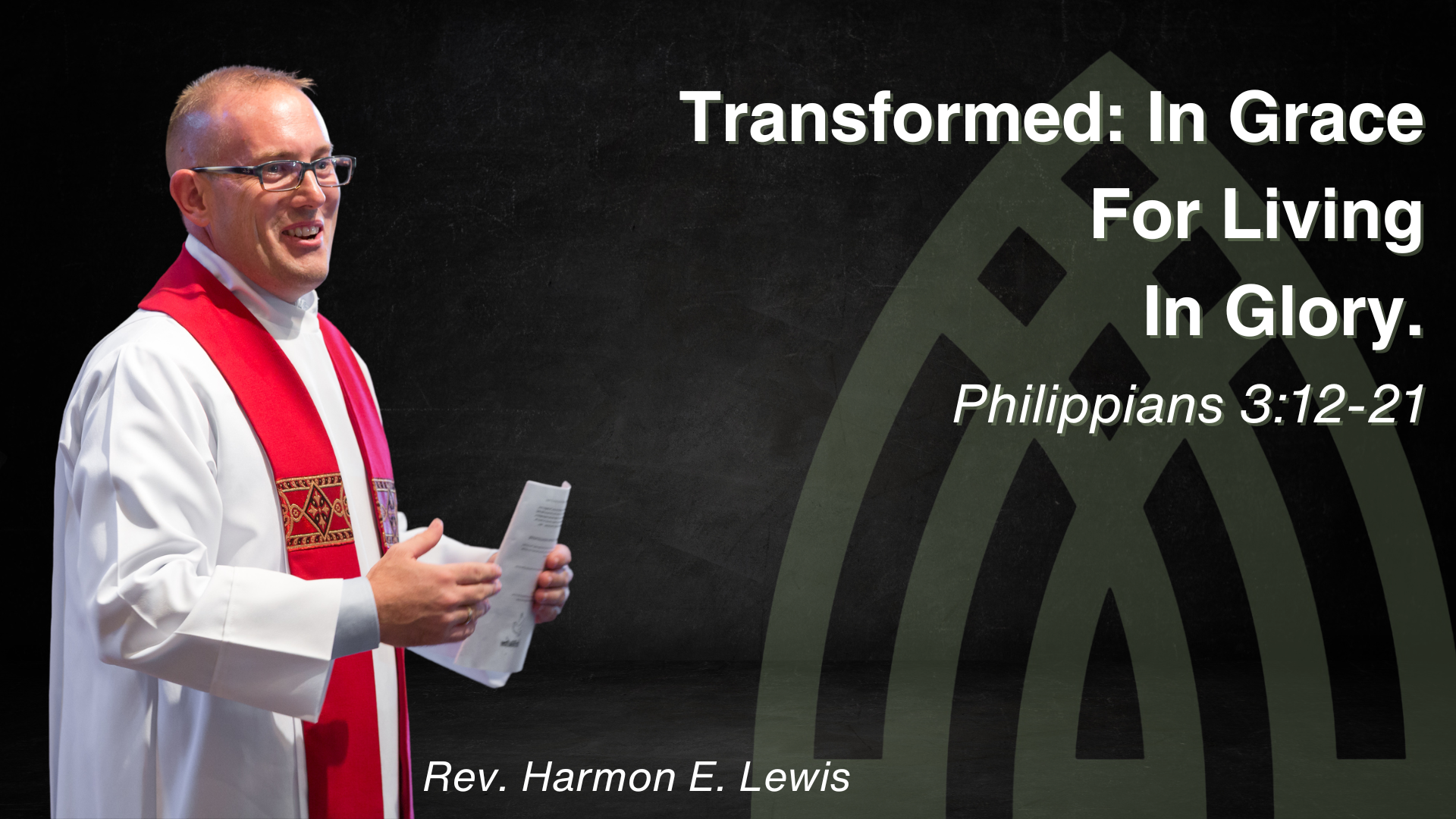
Transformed: In Grace / For Living/ In Glory Philippians 3:12-21
Because we are people of a certain age, Michelle and I spend our evenings watching YouTube videos. On any given evening, you will find us cuddled up on the love seat watching Spenser and Mackenzie build an off-grid cabin out of a shipping container, or Courtney and Riely restoring an abandoned log mansion in the mountains of North Idaho, or Jazmyn and Crystal restore a property in Canada that was once used as a Russian training camp. When we run out of couples there is Tia, a young woman who restores abandoned houses in rural North Dakota with her dad or another Spenser who is a young man from Wichita Kansas who mows lawns that have been neglected for years. Then when Michelle goes to bed I switch back and forth between a guy who is restoring a Porsche as “an investment” or a guy who is rebuilding a boat “for his wife”.
Turns out I am a sucker for a good transformation. Anyone else, or is this just another thing that makes me weird? Maybe for you it is not a transformation of houses and property, cars and boats. Maybe for you it is a transformation of someone’s wardrobe, or makeup, or hair style. I will tell you what, Jamie you can pull a man card from me if you want, but I can spend a hot minute doom scrolling for beard transformations. There is something incredibly satisfying about watching a shabby and unshorn beard trimmed and tamed into an angular masterpiece.
If you, like me, are a sucker for a good transformation than you are going to like today’s epistle lesson because in Philippians 3:12-21 the Apostle Paul describes an epic transformation. It’s not a transformation of a house or property, car or boat, wardrobe or hair. It is the transformation of you. Paul describes how you have been, are, and will be transformed in grace, for living, and in glory.
In order to fully appreciate a good transformation, it is important to get a good look at just how bad things are before you begin the project. You gotta see just how much erosion has compromised the foundation, how thoroughly rust has eaten through the frame, how badly the hair has been infested with lice. It’s discouraging, it’s depressing, it is disgusting, but it is important to see just how bad things are before you begin a transformation otherwise you could look at the finished product and forget how much needed to be done.
When it came time for the apostle Paul’s transformation the inspection revealed serious rot and decay. In fact, humanly speaking Paul was beyond repair and could have rightly been demolished. This guy hated Jesus. He hated everything Jesus stood for, and he hated everyone who followed Jesus. Paul hated Jesus’ followers so much that he made it his mission in life to hunt them down and kill as many of them as he could. Paul was not a fixer upper. He didn’t have good bones. He wasn’t a classic worthy of restoration. Paul was a pile of garbage that deserved to be discarded.
And so were you. And so was I. Sorry. I know it seems rude to say that to you fine Christians, but as you have heard me say about myself, I say about all of us, We were not always the fine upstanding Christians that today we appear to be. In fact, originally, that is before our transformations, we were no better than Paul. In Romans 8:7 The Holy Spirit tells us what our pre-transformation inspection revealed. There the Holy Spirit reports, “7 the sinful mind is hostile to God. It does not submit to God’s law, nor can it do so.” Like Paul we hated Jesus, wanted nothing to do with Jesus, would go out of our way to avoid Jesus. And like Paul we deserved to be discarded like a pile of garbage. In fact, in Ephesians 2:3 that is the conclusion the Holy Spirit comes to. There He refers to us as “objects of wrath”.
By nature, we were all piles of garbage that deserved to be demolished and discarded. Thankfully, however, our God of grace was still willing to transform us. Paul describes his transformation in verse 12 this way. He says, “12 Christ Jesus took hold of me”. For those of you who know Paul’s story you know what he is referring to. He is referring to that come-to-Jesus moment Paul had when he was on his way to Damascus and the ascended Jesus appeared to Paul, knocked him off his donkey, and transformed him from a hater of Jesus into a follower of Jesus. Paul rightly understood that he himself had no part in that transformation. Paul did not seek this transformation. Paul confesses, “12 Christ Jesus took hold of me”.
Christ Jesus has done the same for you. Christ Jesus took hold of you when your parents brought you to this font or one like it and baptismal waters were poured on you in the name of the Father and of the Son and of the Holy Spirit. Christ Jesus continues to hold on to you when His word is preached from a pulpit, taught in a classroom, and read in a home. And every time you step forward to receive His body and blood in with and under the bread and wine, you are being served by a pastor, but make no mistake, it is Christ Jesus who is holding you. Your come-to-Jesus moment may not have been as spectacular as Paul’s, but it was no less effective. Like Paul, you had no part in your transformation. You did not seek your transformation. But, by God’s grace, Christ Jesus took hold of you. You have been transformed in grace.
It is fun to see something that deserved to be demolished and discarded transformed into something of value and worth. But what really makes the transformation satisfying is to see how the thing that was transformed is going to be used. It would be sad to see a transformed house remain abandoned, or a transformed car dumped in the scrap yard, or a transformed wardrobe left in a closet. But it is sadder still to see a transformed Christian not living a Christian life. Which is why in verse 16 Paul encourages the transformed Christian to “16 live up to what we have already attained.” You are a Christian. By grace that is what God has made you to be. You are that now. There is no further transformation needed to make you even more Christian-y-er. You are as Christian as you need to be. When Paul encourages you to “16 live up to what we have already attained” he is not asking you to be something that you are not. Paul is simply encouraging you to be what you already are; what God in his grace made you to be.
God in His grace made you a Christian so that you could live like a Christian. But Paul recognizes that is easier said than done. That is why Paul uses words like “press on” and “straining” when describing what it is like to live a Christian life. Because of our own weak sinful flesh, it is hard enough to live as a Christian, but living a Chrisitan life is even harder because we are surrounded by people who Paul describes as “18 enemies of the cross of Christ.”
Some of these enemies indulge in all sorts of carnal pleasures and desires of the flesh. Some of these enemies are obsessed with luxury and comfort and despise a life of service or sacrifice that accompanies the cross. Some of these enemies deny the sufficiency of the cross and either sink into despair over their guilt and shame or become puffed up with pride as they imagine Jesus needing their works and deeds to obtain righteousness and salvation. Not a one of us here wants to be described as an enemy of the cross but every one of us has given in to the temptations to gratify the desires of the flesh, or shun the sacrifices of the cross, or question the sufficiency of our Savior’s work. In verse 19 Paul warns us about living like enemies of the cross. Paul writes, “19 Their destiny is destruction”.
When you notice yourself acting like an enemy of the cross, confess your sin immediately. Take your sin to the cross where it has been punished and paid. Trust that Jesus has forgiven your indulgences of the flesh, forgiven your reluctance to carry a cross, forgiven your questioning the sufficiency of His work. And then in the assurance of His forgiveness seek out a better example to follow than the ones provided by the enemies of the cross. Seek out the examples of your fellow Christians.
In verse 17 Paul writes, “17 Join with others in following my example, brothers, and take note of those who live according to the pattern we gave you.” Paul offered Himself up as an example of Christian living. And I can see why. Paul was an amazing example of the Christian life. Paul oozed Christianity from his pores; he wanted nothing more than to know Jesus better and better and to share Jesus with more and more people. Paul was far from perfect but even in his struggles to do the good he wanted to do and not do the evil he didn’t want to do Paul was an example of sorrow over sin and confidence in the forgiveness of his Savior. But Paul is as they say, “no longer with us”.
In my life I have known some fine Christian people, but I have not met one I would put on par with Paul, myself included. There is not a single one of us that is living a perfect Christian life. Every one of us has demonstrated, on multiple occasions, we have the potential to make a mess of our Christian lives. It seems like as soon as we get one area of Christian living figured out, we screw up in some other area and when we go to work on the screwed-up area, the area we thought we had figured out starts falling apart again. Not a single one of us can be placed on a pedestal as an example of Christian living for the rest of us.
Thankfully we have each other. God in His grace has made us members of a congregation of Christians who are pressing on and straining to be what God has made them to be. And while there is not one person here that we can look to as an example for every aspect of Christian living, there are examples of patience here, there are examples of kindness here, there are examples of generosity here, there are examples of humility here, there are examples of resilience here, there are examples of service here, there are examples of faithfulness here, there are examples of love here. By God’s grace we are sitting in a room full of examples of Christian living. If you want to grow in your ability to be what God has made you to be then follow those examples and take note of those patterns. God in His grace is using the examples and patterns of your fellow Christians to continue to transform you for Christian living. Who knows, perhaps along the way God will even use you as an example or pattern for others.
Every good transformation ends with a grand reveal where the thing that has been transformed is displayed in all its glory. Yours is the good-est of transformations, so it comes as no surprise that there is a grand reveal being planned for you. In verses 20-21 Paul tells us, “20 But our citizenship is in heaven. And we eagerly await a Savior from there, the Lord Jesus Christ, 21 who, by the power that enables him to bring everything under his control, will transform our lowly bodies so that they will be like his glorious body.”
Your first transformation was by God’s grace, and it made you what you are. At the present time your God of grace has surrounded you with examples and patterns of Christian living so that you can continue to be transformed for living the kind of life God created you to live. But your God of grace has one more transformation planned for you. It is the transformation that will occur when our Savior returns from heaven. On that day Jesus will raise and transform your lowly body so that it will be like his glorious body. No longer will you press on and strain. You will be set free forever from your weak sinful flesh. You will no longer be surrounded by enemies of the cross. You will be surrounded by God's saints and angels. You will finally and perfectly be what God has made you to be, what God always intended you to be. Jesus will transform you in glory.
There is nothing more satisfying than a good transformation. Which is why, on any given night, you can find Michelle and I scrolling through YouTube videos watching one transformation after another. But the greatest transformations of all are the ones our God of grace has performed on you and me. Your God has transformed you in grace. Your God is transforming you for living. Your God will transform you in glory. As I said, there is nothing more satisfying than a good transformation, and yours is the most satisfying transformation of them all. May God fill you with appreciation for the transformation that made you a Christian, that is equipping you to live life as a Christian, and will be gloriously revealed in heaven. Amen.